Scarcity is what breaks the division of labour
Ricardo and Mises showed that specialisation makes everyone capable of becoming richer. Neither guarantees that everyone remains free to produce.
One of the most powerful ideas in economics is also one of the simplest: people become wealthier when they specialise.
Ricardo demonstrated this through comparative advantage. Even where one party is more productive at producing everything, both parties can still benefit when each concentrates on the activities in which their relative advantage is greatest and then trades.
Mises expanded the principle into something much larger. The division of labour was not merely an interesting observation about trade. It was the foundation of human social cooperation itself. By specialising, exchanging and coordinating through markets, individuals collectively produce far more than they ever could in isolation.
At the aggregate level, this is plainly true.
A modern economy could not exist otherwise.
The problem appears when we move one level downward.
The division of labour can increase total production without guaranteeing that every individual retains access to the conditions necessary to participate in that increase. And once those conditions become artificially scarce, the positive-sum logic begins to fracture.
Scarcity is where the problem begins.
Production is positive-sum
Consider the simplest possible economy.
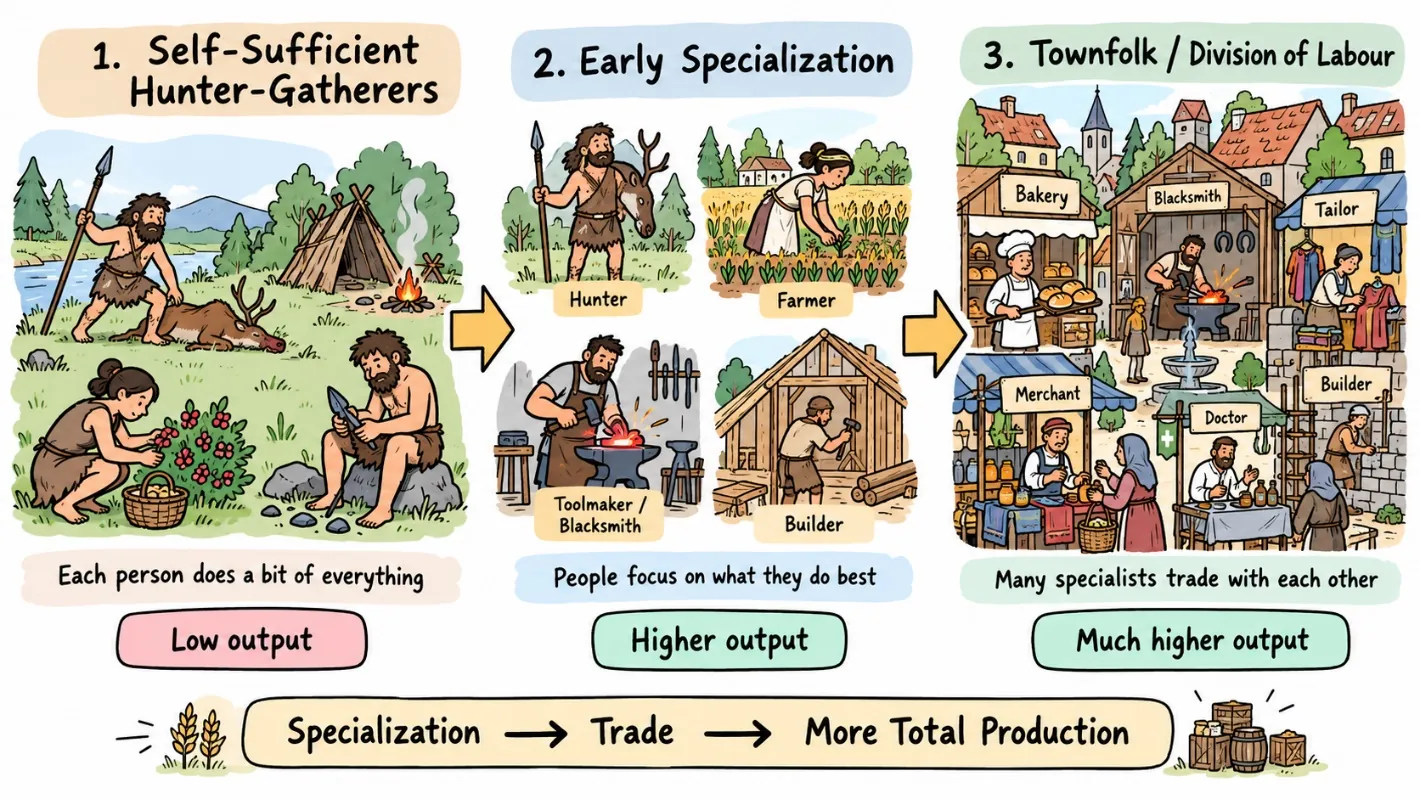
Two people can each hunt, farm, build shelter and make tools. Neither is particularly efficient because each must divide his time among every task required for survival.
If one specialises in farming and the other in hunting, total food production rises. If a third specialises in making tools, productivity increases again. Add a builder, a blacksmith, a merchant and eventually a banker, and the productive output of the group rises many times over.
Nobody had to become poorer for somebody else to become richer.
That is the essential beauty of the division of labour.
The gains emerge because human time is finite. Specialisation allows each person to deploy that time where it produces the greatest value.
The same logic survives even when productivity differs enormously between individuals. A highly productive surgeon still benefits from paying somebody else to repair his roof, not because the surgeon is incapable of doing so, but because the opportunity cost of his time is far greater.
The market therefore pushes labour toward increasingly valuable uses.
In an unconstrained system, the process is self-reinforcing.
Higher prices encourage production. Higher profits attract competitors. Scarcity encourages substitution. Labour migrates toward more valuable activities. Capital seeks higher returns.
The market continually searches for the point at which scarcity and value are most efficiently balanced.
That equilibrium is never permanent. It is constantly being discovered again.
Scarcity changes the distribution
Natural scarcity cannot be eliminated.
There is only so much beachfront land. Mineral deposits exist where geology placed them. Human beings have limited time. Some skills require years of training. Some locations are inherently more desirable than others.
Markets deal with those constraints through prices.
A scarce resource becomes expensive. The higher price discourages less valuable uses while encouraging additional production, substitution or innovation wherever those responses are possible.
This is not a defect of the market mechanism. It is the mechanism.
Scarcity becomes much more interesting, however, when it is not natural.
Suppose the production of some resource is profitable at $100 per unit.
At that price, producers collectively supply one million units.
Now impose a substantial tax on its production.
Some marginal producers are no longer profitable. Investment declines. New projects are abandoned. Existing producers may shift capital elsewhere.
Production falls.
Nothing physical has happened to the resource itself. No mine collapsed. No drought occurred. No geological deposit disappeared.
Yet the resource has become scarcer.
The scarcity has been manufactured through altered incentives.
This distinction matters because every economic activity ultimately occurs at the margin.
People do not decide whether work, investment or production are worthwhile in the abstract. They decide whether the next hour worked, the next factory built or the next dollar invested is worthwhile relative to the alternatives available to them.
Change that calculation and behaviour changes with it.
The missing high earner
Consider taxation at the level of an individual.
Suppose a highly productive worker can increase his income by working additional hours, taking greater responsibility, starting a business or developing some new skill.
At a sufficiently high marginal tax rate, the return on that additional effort declines.
Eventually another activity becomes preferable.
He works fewer hours.
He declines the promotion.
He does not start the business.
Or he moves to another jurisdiction.
From his perspective, this may be perfectly rational.
But notice what has disappeared.
The lower-income worker who was supposedly helped by the higher tax rate does not somehow receive the output that the higher-income worker decided not to produce.
The additional service is not performed.
The business is not created.
The investment is not made.
The taxable income itself disappears.
The economy has not redistributed an existing quantity of production. It has changed the incentives governing whether that production occurs at all.
The distinction is critical.
Redistribution is usually discussed as though economic output exists independently of the rules governing its creation. It does not.
Production is an action.
Tax the action heavily enough and less of it will occur.
The resulting scarcity then affects everybody who would otherwise have consumed, purchased, invested alongside or indirectly benefited from the missing production.
Nobody receives the surgery that the surgeon never performs.
Nobody works for the company that was never created.
Nobody purchases the goods that were never manufactured.
The lost output does not sit in a warehouse waiting to be redistributed.
It simply never exists.
The market seeks abundance
This gives us a useful distinction between natural scarcity and imposed scarcity.
Natural scarcity is something markets continuously attempt to overcome.
If copper becomes expensive, engineers search for substitutes.
If labour becomes expensive, businesses automate.
If land becomes expensive, developers build upward, outward or more densely.
If one region becomes expensive, people and capital move elsewhere.
Entrepreneurial activity is in large part a continuous assault on scarcity.
Profit is the reward for finding a cheaper, faster or more abundant way of satisfying demand.
The free market therefore tends toward the lowest sustainable point between scarcity and value.
Not zero scarcity. That is impossible.
Rather, the minimum scarcity achievable given physical reality, consumer preferences and available technology.
Artificial restrictions interfere with that process.
They do not merely redistribute the existing outcome. They change the outcome itself.
Taxes suppress marginal production.
Licensing restricts entry.
Quotas restrict quantity.
Tariffs restrict substitution.
Planning controls restrict construction.
Capital controls restrict movement.
Regulation can make previously viable production economically impossible.
Every additional restriction narrows the set of actions individuals may profitably undertake.
And narrowing the set of possible actions necessarily creates additional scarcity somewhere in the system.
Housing makes the mechanism visible
Housing provides one of the clearest examples because the physical resource involved appears, superficially, to be land.
Australia has an enormous amount of it.
Yet its major cities routinely experience severe housing scarcity.
Thailand provides an instructive contrast. Property construction in many areas is considerably less constrained, development is widespread, and vacant or surplus housing is common.
The difference cannot simply be explained by the physical availability of land.
The relevant scarcity is produced through the interaction of zoning, planning restrictions, infrastructure policy, construction regulation, taxation, credit conditions and political resistance to additional development.
A city may contain abundant physical land while simultaneously containing very little land upon which government will permit the market to build what people actually want.
The economically relevant supply is therefore not the quantity of land.
It is the quantity of usable land under the prevailing rules.
Once this distinction is understood, apparently paradoxical outcomes become easier to explain.
Rising incomes do not automatically produce better housing.
If housing supply is heavily constrained, higher incomes instead allow buyers to bid more aggressively for the same limited stock.
Productivity rises.
Wages rise.
The division of labour has succeeded.
But much of the gain is capitalised into the price of the scarce asset.
The worker becomes more productive without becoming proportionately better housed.
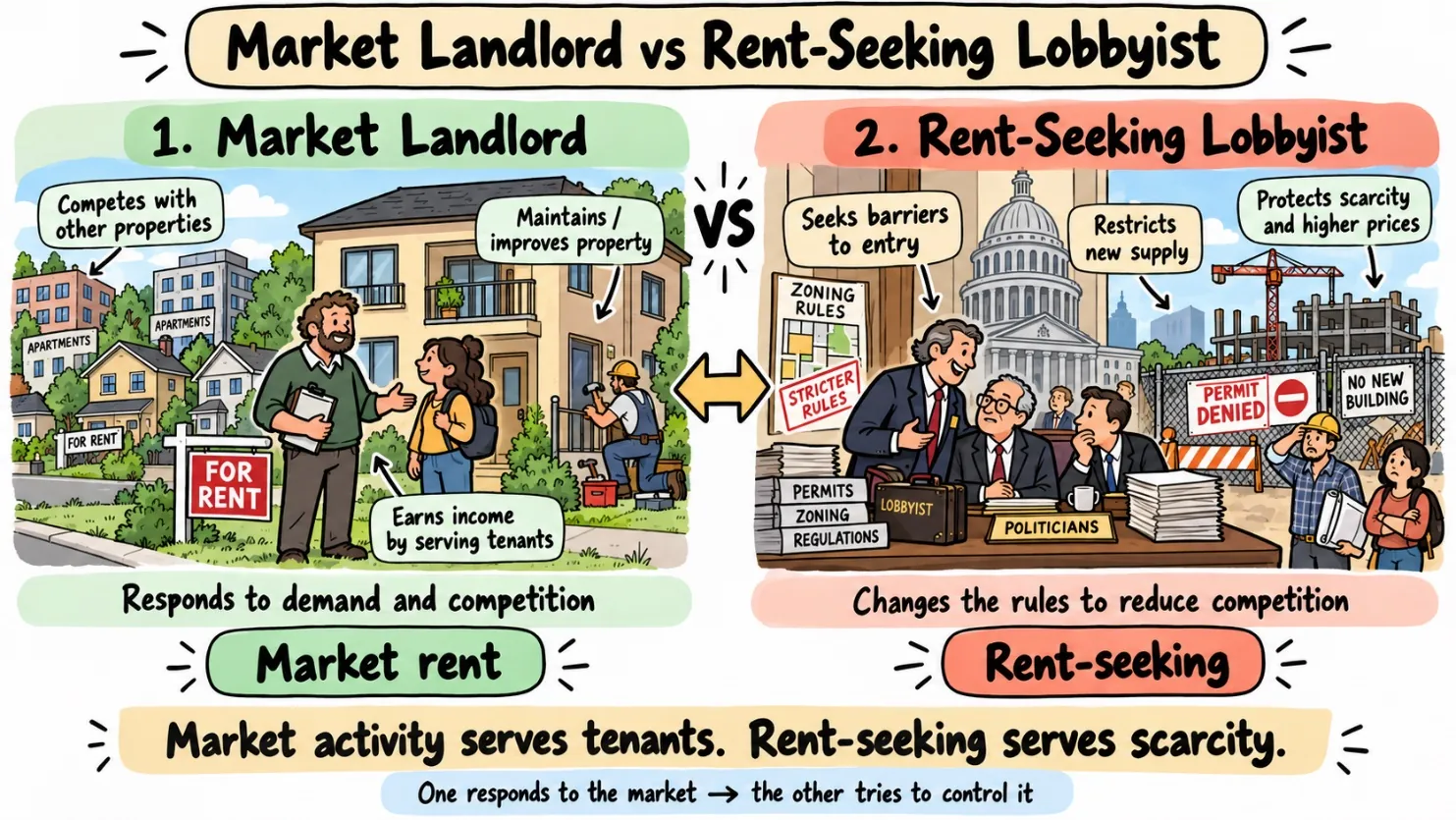
This is not ordinary market rent.
Genuine rent reflects scarcity, risk, capital allocation and consumer demand. Those signals help coordinate markets.
Rent-seeking is different.
Rent-seeking attempts to create or preserve scarcity by preventing competition, restricting entry or obtaining political privilege.
The distinction matters enormously.
A landlord earning a return because people value a particular property is participating in a market.
An incumbent lobbying to prevent competing properties from being constructed is attempting to alter the market itself.
The first responds to scarcity.
The second seeks to manufacture it.
Capital is not exempt
The same mechanism extends into capital markets.
Under modern fractional-reserve fiat systems, governments, central banks and regulated financial institutions exert enormous influence over the availability and price of credit.
The result is particularly visible in assets whose supply is constrained.
When credit expands faster than the supply of desirable housing, additional purchasing power does not necessarily create additional houses.
Instead, buyers compete for the existing stock with larger pools of borrowed money.
Prices rise.
Credit therefore interacts with artificial supply restrictions in a particularly powerful way.
One institution affects the quantity and price of money.
Another set of institutions constrains the quantity of assets money is permitted to create.
The combination can transform productivity gains, wage growth and monetary expansion into rapidly increasing asset values.
Once again, the problem is not that markets contain scarcity.
They must.
The problem is that institutional control can create scarcity that otherwise would not exist, while simultaneously determining who is best positioned to own the assets benefiting from it.
Property rights are only as real as the rights retained
The Austrian School’s response to much of this is straightforward:
Private property and market prices exist precisely because resources are scarce.
Correct.
Prices allow competing uses to be compared. Property rights allow owners to allocate resources. Profits reward those who satisfy consumers most efficiently.
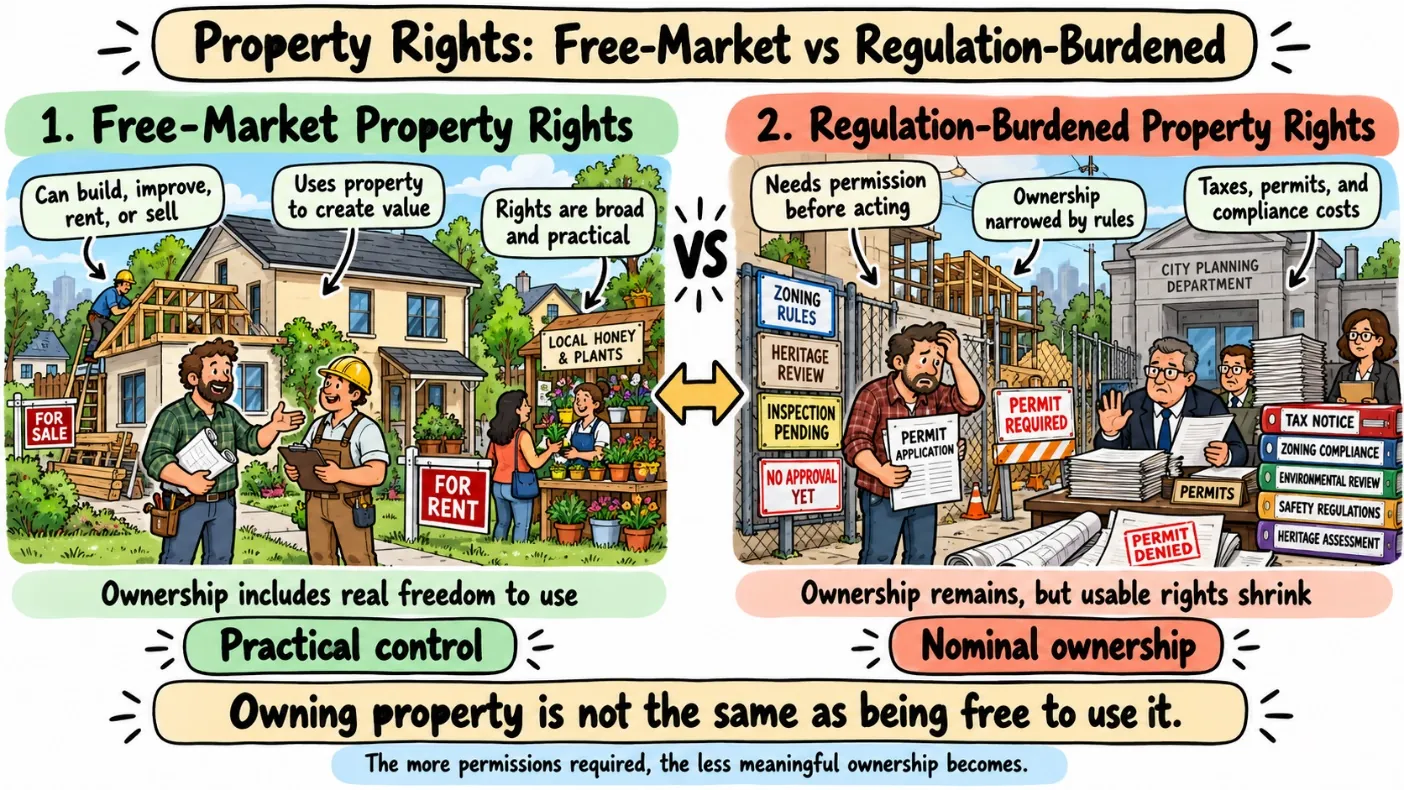
The problem is that ownership in a heavily regulated economy is rarely absolute in the economically relevant sense.
A landowner may own land but be forbidden to build additional dwellings upon it.
A business owner may own capital but be forbidden to employ it without particular licences.
An investor may own money but face restrictions on where it can move.
A producer may legally own a resource while taxes render its extraction uneconomic.
Nominal ownership remains.
The practical rights associated with ownership shrink.
This creates an odd hybrid.
Markets are still expected to allocate resources efficiently, but the actions available to market participants are progressively constrained by institutions outside the market.
When the resulting scarcity produces high prices, those prices are then frequently blamed on the market itself.
Yet the market is merely pricing the scarcity it has been given.
The politics hiding underneath
At this point the argument becomes incisive because the pattern is no longer merely economic.
It is political.
Every political intervention changes the set of actions available to individuals.
Some actions become more expensive.
Some become less profitable.
Some require permission.
Some become illegal.
Some forms of competition disappear completely.
Those changes alter production.
And because production is the foundation upon which redistribution occurs, every intervention changes not merely who receives wealth but how much wealth exists to distribute in the first place.
This produces a conclusion that sits uneasily beside the conventional division-of-labour story.
The division of labour is positive-sum because people voluntarily reorganise scarce time and resources toward more productive uses.
Political allocation works in the opposite direction.
It restricts some voluntary uses in favour of others.
Even where its intention is redistribution rather than restriction, it necessarily alters incentives, prices and production at the margin.
The economic pie is therefore not fixed before politics divides it.
Politics changes the recipe.
This does not mean every affected individual necessarily becomes poorer in every instance. Particular people may gain enormously from a particular intervention.
That is precisely the problem.
Once political power can manufacture scarcity, control over that power itself becomes economically valuable.
Businesses seek licences that competitors cannot obtain.
Property owners oppose construction that might dilute scarcity.
Industries seek tariffs.
Professions seek barriers to entry.
Asset owners favour policies that support asset values.
Recipients of privilege rationally defend the privilege.
Rent-seeking follows naturally.
The economy remains positive-sum in aggregate because human cooperation, technology and specialisation continue creating wealth.
But layered across it are increasingly zero-sum contests over access to the bottlenecks political systems have created.
And that is where the elegant Ricardian and Misesian story finally reaches its limit.
The division of labour can make everyone capable of becoming richer.
It cannot guarantee that everyone remains free to produce.
Natural scarcity sets the boundaries within which human action occurs.
Markets continuously attempt to push those boundaries outward.
Political systems can only add further constraints.
They can redistribute access to scarcity, subsidise it, tax it, regulate it, protect it or manufacture more of it.
But they cannot repeal scarcity.
The paradox is therefore simple:
The division of labour creates wealth by allowing individuals to pursue the activities they value most.
Every imposed restriction narrows those choices.
Enough restrictions, layered upon one another, convert portions of a positive-sum economy into contests over increasingly scarce opportunities.
Scarcity does not destroy the division of labour.
It reveals its boundaries.
And artificial scarcity is the means by which politics moves those boundaries inward.