AI Integration Is Not Enough
Most firms are bolting AI onto software designed around the division of human labour. The larger opportunity is to redesign the system itself.
Almost every professional is now using AI. They ask ChatGPT to draft an email, Claude to summarise a document, Copilot to help with Excel formatting, or enlist one of the rapidly growing number of other AI assistants being added to existing professional software.
And yet, despite an extraordinary improvement in the underlying technology, most professional work still looks remarkably similar to how it did five years ago.
This is not because AI isn't useful. It is because we are integrating AI into software and processes that were never designed for it.
We are making the existing system smarter, one application at a time, without changing the system itself.
Smarter silos are still silos
Consider a fairly ordinary accounting firm.
The client's bookkeeping might sit in Xero. Supporting documentation is stored in Dropbox or SharePoint. Emails are in Outlook. Year-end workpapers are prepared in MYOB or another accounting package. Calculations are performed in Excel. Financial statements may be generated somewhere else again. The tax return sits in tax software.
These are not separate pieces of work. They are different stages of one process.
But our software treats them as separate because historically they were separate human tasks.
A bookkeeper maintained the accounting file. An accountant prepared the year-end adjustments. Perhaps a second accountant prepared the workpapers. Financial statements were drafted. Tax calculations were completed. The return was prepared and reviewed, again probably by several different staff.
The architecture of professional software largely reflects the historical division of labour between people.
That made perfect sense when humans were doing all the reasoning.
It makes considerably less sense when we start inserting artificial intelligence into the process.
So what are software companies currently doing?
Xero gets AI. Microsoft gets Copilot. The document management system gets AI search. The workpaper package gets its own AI assistant. Tax software starts offering AI features.
We end up with five intelligent systems that still don't know what the other four are doing, or that they even exist.
We have made every silo smarter without removing the silos.
That is useful (maybe). It is not transformation.
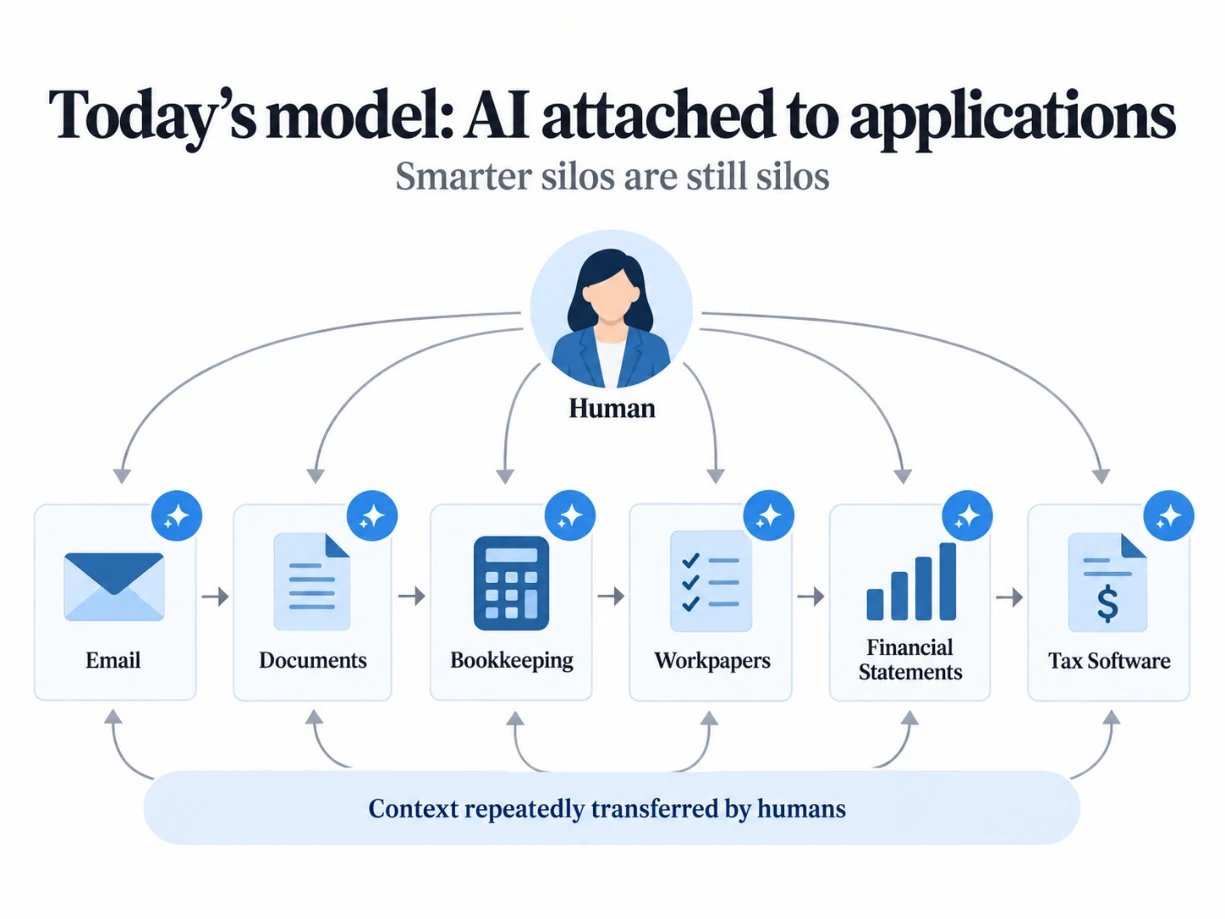
Today: AI attached to applications
Email + AI → Bookkeeping + AI → Workpapers + AI → Financial Statements + AI → Tax Software + AI
Human moves context, reconciles differences and connects each stage.
The problem isn't intelligence — it's context
Large Language Models (LLMs) can do remarkable things, but they can only reason reliably about the information available to them.
A senior accountant looking at a strange transaction doesn't see one line in a ledger.
They might remember an email from the client three months ago. They know how the same item was treated last year. They know that a document sitting in Dropbox explains part of the transaction. They know something unusual about the ownership structure. They understand the client's business and recognise that the transaction doesn't make commercial sense.
That peripheral context matters.
An external AI assistant may have access to the general ledger but none of the rest of it. Giving it access to Xero makes it more useful. Giving it access to email makes it more useful again. Connect the document system, tax software, workpapers and prior-year records and eventually you can reproduce much of what the human knows.
But notice what we have just done.
We have built an enormous orchestration layer around half a dozen systems which were originally designed for experienced humans to operate independently.
This is why simply attaching increasingly capable models to existing professional software eventually hits a ceiling. The AI itself can continue improving while the surrounding architecture becomes the constraint.
One transaction should only need to change once
Take a simple example.
Suppose an accountant discovers that a $100,000 item of plant and equipment has been incorrectly posted to repairs and maintenance.
Today, correcting that transaction might mean changing the bookkeeping file, refreshing or importing the workpapers, updating the fixed asset register, recalculating depreciation, updating the tax calculation, refreshing the financial statements and changing the tax return.
A good accountant understands the chain immediately.
Our software generally does not.
AI assistants might help at several of those stages. One might identify that the transaction looks unusual. Another might suggest the correct accounting treatment. Another might help explain the tax consequences.
But the accountant is still the person carrying the change through the system.
Now imagine software built around the process rather than around the historical tasks.
The transaction is corrected once.
The system recognises that the expenditure is capital. The fixed asset register updates. Accounting depreciation changes. The relevant tax treatment is applied. The tax reconciliation updates. The financial statements change. The tax return changes. Any assumption requiring professional judgement is flagged for review, and the entire chain is retained in the audit trail.
That does not require some hypothetical superintelligence.
Most of the underlying reasoning is already well within the capabilities of current AI models.
What is missing is the system around them.
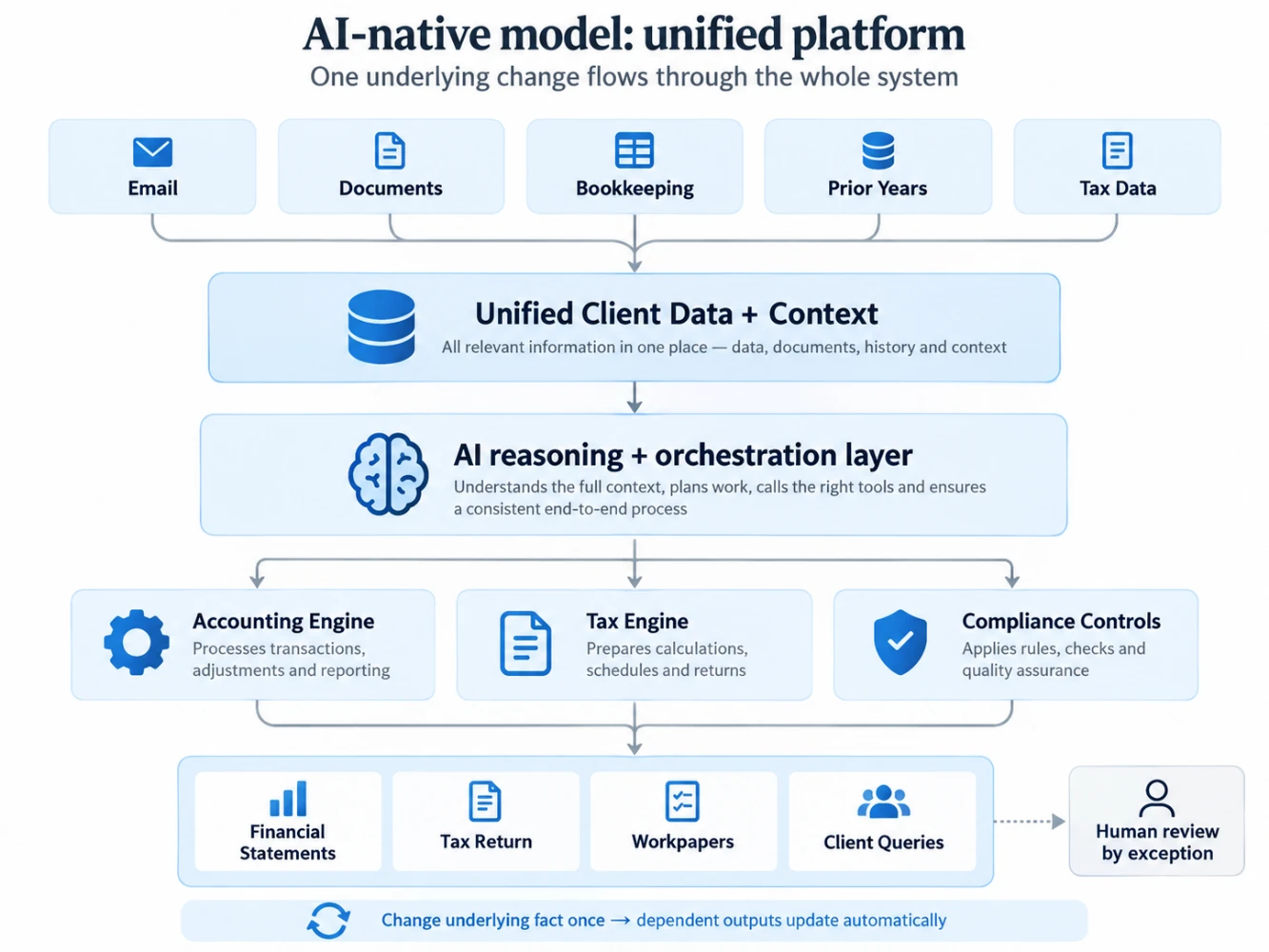
AI-native system
Email + Documents + Bookkeeping + Prior Years + Tax Data
↓
Unified client data and context
↓
AI reasoning / orchestration layer
↓
Accounting + Tax + Compliance processes
↓
Outputs + review exceptions
Change an underlying fact once and every dependent calculation and output updates.
AI is unusually good at moving between forms of information
Databases remain much better at storing structured data than language models are.
But AI is extraordinarily useful at parsing, reorganising, restating and moving information between different forms.
It can read an email and connect it to a transaction. It can take an unstructured document and extract accounting information. It can explain why an entry has changed. It can compare the current year against the previous year. It can identify inconsistencies between different records. It can take the same underlying information and express it as a calculation, a workpaper note, a financial statement disclosure or a client query.
In other words, AI can become the connective tissue between what are currently separate systems.
But only if the system gives it the information and context required to do so.
Putting a chatbot inside every application does nothing to achieve that.
The next generation of professional software needs different designers
There is another reason this change may take longer than people expect.
The difficult part is probably not the AI models themselves.
Software developers are very good at building software, but they rarely have ten or twenty years of professional experience in accounting, law, engineering, finance or whatever industry they are building for.
Meanwhile, the people who understand those professions deeply usually cannot build software.
That creates a peculiar gap.
The accountant knows that when X occurs you normally check Y, except where Z applies, and that a particular exception should be escalated to a manager rather than automatically processed.
The programmer knows how to make the computer perform those instructions.
Historically, converting one into the other required teams of developers, product managers, consultants, specifications, meetings and endless translation between people who understood completely different parts of the problem.
AI coding may start to collapse that gap.
For the first time, a professional who understands the process may be able to build substantial parts of the software required to redesign it.
The next generation of accounting software may therefore not be designed by programmers asking accountants what accountants do.
It may increasingly be designed by accountants who can now program.
The same should apply elsewhere.
The firms merely "adopting AI" may be disappointed
Almost every firm will adopt AI tools.
That will quickly cease to be a meaningful competitive advantage.
Buying Copilot licences, giving staff ChatGPT accounts and enabling AI functions inside existing software will produce some productivity improvements. Emails will be written faster. Research will improve. Documents will be summarised more quickly. Routine analysis will take less time.
But firms expecting those tools alone to fundamentally change their economics may be disappointed.
They are still asking humans to operate the same underlying production system.
The much larger opportunity is to redesign that production system from the ground up.
Professional software today is largely organised around the limitations and division of human labour. The software of the next decade does not have to be.
Once the underlying data, context and reasoning can move through one integrated process, AI stops being an assistant sitting beside the professional.
It becomes part of the machinery.
And that is where the real leverage begins.